
Payload CMS: Discover the Future of Content Management
In today's digital world, a powerful and flexible content management system (CMS) is essential for efficiently running websites and managing content in a targeted manner. Payload CMS has established itself in recent years as an innovative solution that particularly impresses with its user-friendliness and technical integration. This article examines why Payload CMS is considered a forward-looking system, what advantages it offers, and how it helps companies take their web projects to the next level.
What is Payload CMS and Why is it Gaining Importance?
Payload CMS is a modern, open source headless content management system that stands out for its flexibility and ease of use. Unlike traditional CMS that are often built monolithically, Payload CMS clearly separates backend and frontend. This enables developers to design custom user interfaces while editors can manage content straightforwardly.
The Role of Headless CMS in the Modern Web
Headless CMS like Payload separate content management from the presentation layer. This means content is stored centrally and can be delivered via APIs to various frontends – whether a website, a mobile app, or other digital channels. This flexibility is essential today, as companies increasingly rely on omnichannel strategies.
Payload CMS offers not only typical headless functionalities but also functions as a complete backend system. This facilitates integration into existing IT architectures and enables seamless collaboration between developers and content managers.
Another advantage of Payload CMS is the ability to create and manage custom content. Payload comes with no predefined content types – these can be individually adapted to requirements. This is particularly advantageous for companies with specific requirements who need tailored solutions. Additionally, Payload CMS's user-friendly interface enables even less technically versed users to effectively create and edit content, increasing team productivity.
Furthermore, security plays a crucial role in today's digital landscape. Payload CMS offers robust security features that ensure sensitive data is protected. With regular updates and an active support team, the platform is designed to minimize potential security risks. This gives companies the assurance that their content and data are in safe hands while they enjoy the benefits of a flexible and modern CMS solution.
User-Friendliness and Technical Integration: An Unbeatable Duo
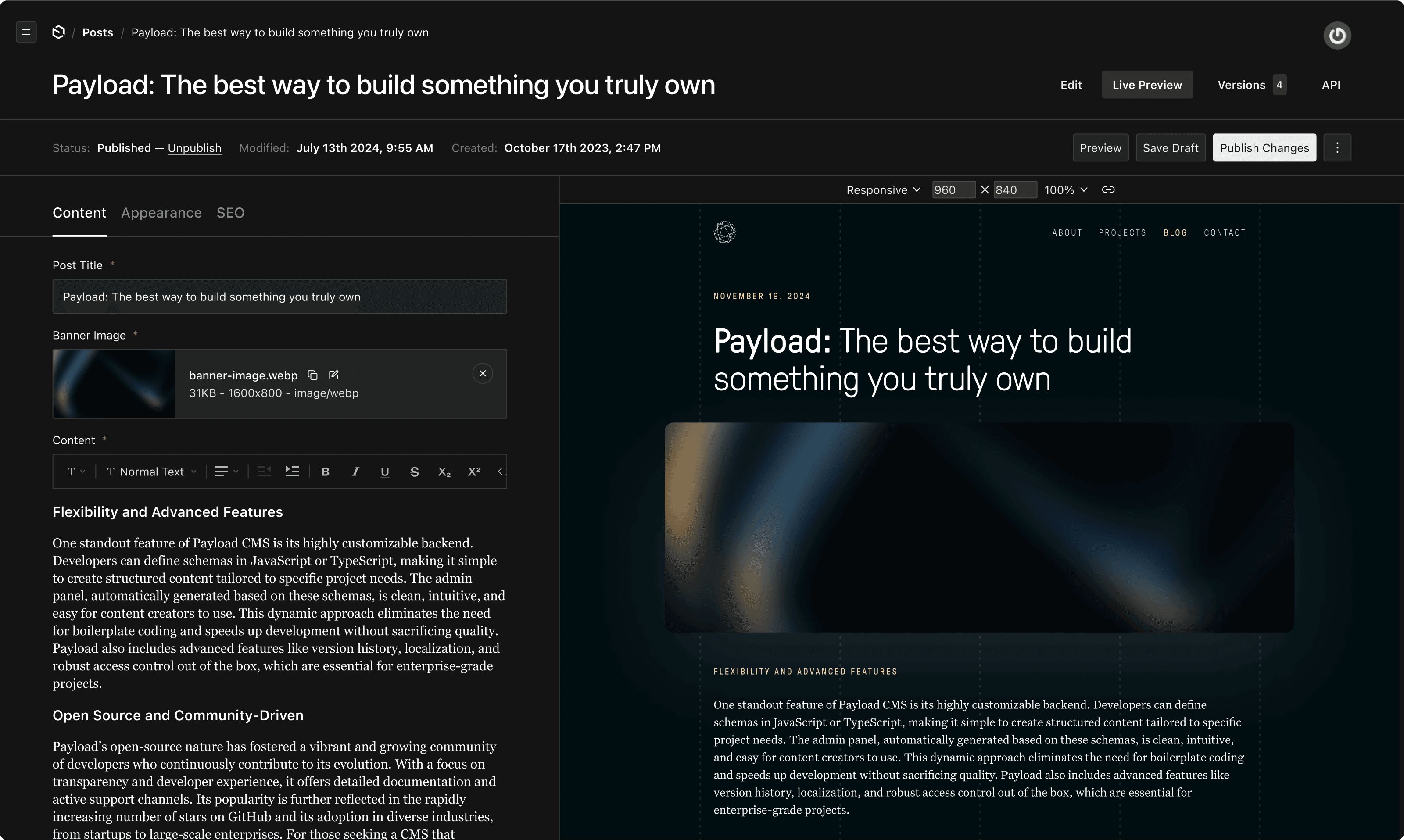
A key advantage of Payload CMS is its intuitive user interface. This user orientation ensures that even less technically versed editors can quickly work productively.
Next.js Integration as Technical Highlight
One of the newest and most significant developments at Payload CMS is the complete integration with Next.js. Next.js is a popular React framework known for its performance and flexibility. This connection creates a seamless bridge between backend and frontend, enabling fast loading times and an improved user experience.
Payload CMS can function not only as a headless CMS but as a complete backend system that fits excellently into existing architectures. For example, a custom e-commerce system can be developed with Payload, including product and user management. This integration facilitates the development of modern web applications and significantly reduces effort for developers.
Another advantage of combining Payload CMS and Next.js is server-side rendering (SSR) support. This feature enables content to be dynamically generated before being sent to the user. This not only leads to faster loading times but also improves SEO performance, as search engines can more easily index complete page content. Developers can thus ensure their web applications are optimally optimized for both users and search engines.
Additionally, Payload CMS offers a variety of customization options that enable developers to create tailored solutions. With the ability to define custom fields and structures, companies can meet specific requirements and organize their content exactly according to their ideas. This promotes not only creativity but also efficiency in content creation and management.
Payload CMS in Comparison: Why it Pays Off for Companies
In the area of web content management, Payload CMS has received an impressive average rating of 4.8 according to Gartner. This feedback reflects user satisfaction and confirms the system's quality and reliability.
Scalability and Adaptability
Payload CMS is particularly interesting for companies seeking scalable and customizable solutions. The flexible architecture allows the CMS to be adapted to individual requirements – whether through custom plugins, API extensions, or tailored workflows. This makes Payload a future-proof choice that grows with a growing company's needs.
Another advantage is the ability to manage multiple projects simultaneously, which is particularly significant for agencies or companies with various brands. This flexibility allows resources to be used efficiently while ensuring content quality across different platforms.
Efficiency Gains Through Modern Technologies
The combination of headless CMS and modern frontend technology like Next.js ensures high performance and better developer experience. Companies benefit from faster development cycles and better maintainability of their web projects. At the same time, editors can manage content independently of technical implementation, significantly increasing efficiency in content management.
Additionally, the integration of modern tools and frameworks enables seamless collaboration between developers and content teams. Through the use of APIs, content can be dynamically loaded and displayed, improving the user experience. This separation of backend and frontend promotes not only developer creativity but also the flexibility of editors who can update content in real-time without relying on technical support. This leads to an agile way of working that is essential in today's fast-paced digital world.

Practical Examples and Application Areas of Payload CMS
Payload CMS is used in various industries and for different use cases. From corporate websites to e-commerce platforms to complex web applications, the system offers a broad range of applications.
Content Management in Transition
Requirements for content management systems are constantly changing. Users expect not only appealing and fast websites but also consistent presentation across different devices and platforms. Payload CMS supports this development through its headless architecture and modern integration options.
Furthermore, the user-friendly interface facilitates daily work with content, which is a crucial advantage especially in times of high content production. The ability to edit content in real-time and receive immediate previews enables editors to work more efficiently and increase the quality of published content.
Another advantage of Payload CMS is multi-language support, which is of great importance for internationally operating companies. Through easy management of multilingual content, companies can ensure they effectively reach their target audiences in different markets and consistently communicate their brand message.
Conclusion: Payload CMS as Pioneer for the Future of Content Management
Payload CMS combines cutting-edge technology with ease of use and high flexibility. The integration with Next.js, positive user ratings, and growing adoption suggest that Payload CMS will play an important role in the future of content management.
Companies looking for a scalable, powerful, and user-friendly CMS will find a future-proof solution in Payload that equally delights both developers and content managers. The combination of headless architecture and comprehensive backend makes Payload CMS a versatile tool that meets the demands of modern web projects.
Another advantage of Payload CMS is the ability to create and manage customized content tailored to the specific needs of the target audience. This enables a personalized user experience that is crucial in today's digital landscape. Additionally, Payload CMS supports a variety of integrations that enable companies to seamlessly connect their existing systems and tools, further increasing efficiency and productivity.
The community around Payload CMS is steadily growing, which means users have access to a variety of resources, tutorials, and support. This active community promotes knowledge exchange and collaboration, which in turn leads to continuous improvement and evolution of the system. For companies wanting to succeed in a rapidly changing digital environment, choosing a CMS that is not only technologically advanced but also supported by an engaged community is of utmost importance.
Anyone wanting to discover the future of content management should definitely have Payload CMS on their radar.